"Disabled" is not My Identity
I don’t identify as being disabled (or dis-abled). Are there things I can’t do? Yes. But that is true for all of us, isn’t it? Every person has strengths, challenges, limitations, and areas where we need help. We were never designed to carry everything alone.
When health challenges pile up, it can be easy to believe we’re somehow instantly disqualified. A diagnosis, limitation, difficult season, or body that does not cooperate can feel like a closed door. But a diagnosis does not disqualify a person from purpose. It may require accommodations, pacing, rest, or a different way forward, but it does not cancel God’s calling, erase value, or remove the gifts He placed inside us.
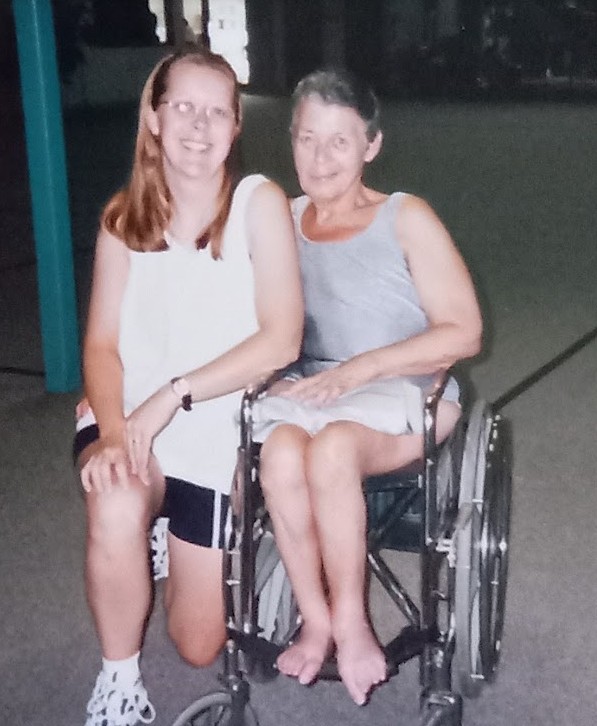 I grew up with a mother who used a wheelchair after contracting polio as a child. She was breaking barriers long before ADA laws existed, and never modeled hoplessness. My mom was a college graduate who worked non-stop until she was medically retired from her last job as Director of Child Care Programs for a US Navy Base. She drove an hour to and from work each day. Through her 50's and 60's, she gardened with determination, moved heavy pots with her wheelchair, went to the gym to swim laps in the pool, and sometimes made her way around the indoor walking trail on her knees. By her example, I learned early that “dis-ability” is often simply a differing ability. (In this gym photo, my mom was 60 years old.)
That lesson shaped how I see my own life. As a child, I loved writing letters, journaling, taking notes, and figuring out how things work. Writing things down helped me compensate for the challenge of remembering things. Research and study helped me process what did not come quickly. Over time, that compensation became a strength. It helped me explain things to others, write books, and use what once felt like limitation as a gift. Sometimes the very thing we develop because of a struggle becomes the thing God uses to bless someone else. What looks like weakness in one season may become wisdom in another.
When the body glitches, pain lingers, and answers are slow, it can wear on the soul. Over the past two-plus years, I've spent a lot of time seeking answers. I understand why some people do not want a diagnosis; labels can feel heavy. But for me, diagnosis brought clarity. Without a diagnosis, it can be difficult to receive treatment, accommodations, or proper consideration for related conditions.
When I was 58, I was diagnosed with autism burnout, which also meant I was diagnosed with autism. Without that diagnosis, I may never have considered MCAS, dysautonomia or hypermobile Ehlers-Danlos Syndrome. About 90% of my lifetime medical struggles actually fall under hEDS. Cancer, of course, is its own beast. But the hEDS diagnosis gave me a new set of lenses through which to view my health experiences.
That understanding has given me more compassion for myself. It helped me look back on times my concerns were ignored, I was told to push through pain, and I wondered whether something was wrong with me spiritually because my body was struggling physically. Pain does not mean a person lacks faith. Medical differences are not imaginary simply because others cannot see or understand them.
This is part of why being rooted in Christ’s identity matters so deeply to me. My books, When Faith Is Shaken and Rooted in Christ’s Identity, grew from this place of wrestling, healing, and returning to the truth of who God is and who He says we are. Wholeness does not always mean circumstances change immediately. Sometimes healing looks like learning to rest without guilt, speaking truth without fear, and living from identity rather than pressure.
Recently, I have been asking God to shine His light on areas of internal conflict creating unnecessary tension in my life. I am asking Him to reveal burdens I have been carrying, limitations I may have accidentally come into agreement with, and priorities that may need reevaluating in this season. What worked before may not work now, and wisdom gives us permission to pause, reassess, and realign our goals.
Many of my struggles seem to arise not because I lack values, but because several deeply held values are asking for attention at the same time. I want connection, but I also need space. I want to help others, but I also need to protect my health. I value authenticity, but I also want harmony. I value independence, but I also need support. None of these values are wrong, but when they compete, I need God’s wisdom to discern what faithfulness looks like right now.
I am learning that I can respond with wisdom instead of impulse. I can bring my anger, weariness, confusion, and competing values into the presence of God and ask Him to show me what peace looks like in this moment. That does not mean denying pain. It means allowing God’s goodness and faithfulness to meet me right where I am.
Paul wrote, “I want you to know, dear ones, what has happened to me has not hindered, but helped my ministry of preaching the gospel, causing it to expand and spread to many people” (Philippians 1:12, TPT). What happened to Paul did not stop the gospel. In God’s hands, even hardship can become part of the testimony.
Life is not all-or-nothing. We do what we can within our limited capacity for “common sense,” and we trust God for the rest. I am not disabled or disqualified. I am learning, adapting, healing, recovering, and becoming more fully rooted in Christ. If you can relate to any of this, what would it look like to bring your limitations, values, and next steps before God and ask Him to show you the path of peace?
.png "Maggie's Legacy")