When Healing Becomes a Full-time Job
My healing journey continues, and lately I have been thinking about healing in a somewhat different way. I am still learning about my body and paying attention to what it needs, but I am also learning to pay attention to something deeper: what chronic pain has taught me to believe about myself, and how easily even the pursuit of healing can begin re-organizing a life.
Pain asks for attention. Trauma asks for protection. A worried part of us asks for control. The brain predicts based on what it has learned, and our thoughts begin telling stories about what sensations mean. Another appointment, flare, unexpected trip to the emergency room, or canceled plan can reinforce those stories. Another hour researching what the body is doing and what new treatment might bring relief keeps our attention there. Then, almost imperceptibly, something we experience can become something we believe we are.
The shift can be subtle. “My back hurts” becomes “I have a bad back.” “I’m having difficulty doing this today” becomes “I can’t do that anymore.” When pain is persistent, it becomes harder to separate what we are experiencing from who we believe ourselves to be. The enemy is more than willing to use that repetition to convince us that something must be seriously and permanently wrong with us.
The past few years of my own life became heavily organized around medical appointments as I searched for relief from pain and dysregulation. I learned to research, prepare, track symptoms, advocate for myself, and keep looking for answers. Those things can be useful and sometimes necessary. But somewhere along the way, I realized that healing involves more than asking, How do I make this symptom stop? There is another question worth asking: What has this experience taught me to believe about myself?
One surprisingly simple practice has been learning to notice an experience without becoming fused with it. Notice the difference between saying, “I am anxious,” and “I notice anxiety is present.” There is even a difference between “I am in pain” and “Pain is visiting today.” The pain has not disappeared, but the language creates a little space between what I am experiencing and who I am.
I can do something similar with thoughts. Instead of automatically accepting, Something is wrong, I can notice, I am having the thought that something is wrong. I have not denied what my body is experiencing. I have simply stopped allowing the thought to introduce itself as unquestioned fact.
Sometimes attention to the body is necessary. Pain can be an important signal. Red flags should not be ignored, and our bodies sometimes need rest, medical care, nourishment, movement, or recovery. Learning to notice what is happening gives us an opportunity to respond appropriately without allowing every sensation to tell us who we are.
Pain is information. It is not identity.
As a Christian, I am learning to take that discernment another step by asking, What is bearing witness here? What is true? There is a profound difference between investigating a problem and assigning an identity. What’s wrong? can be a legitimate question. But repeated often enough, What’s wrong… with me? becomes something very different.
Scripture gives us the language of testimony. Romans 8:16 says, “The Spirit himself testifies with our spirit that we are children of God.” My body may testify, This hurts. My history may testify, Something painful happened here before. Fear may testify, Something bad could happen again. None of those realities needs to be denied, but none has the authority to complete the sentence: Therefore, this is who you are.
The Spirit bears another witness: I am God’s child. Pain can be present without becoming my name.
I am also recognizing another way chronic illness can begin defining us. Sometimes illness does not become our identity because we surrender to it. Sometimes fighting illness becomes our identity. Every lab workup or PT workout becomes a test. Every meal becomes a treatment. Every supplement becomes a strategy. Every appointment becomes preparation for battle. Every good day means we are winning, while every flare feels like losing ground.
I recognize something of that pattern in myself. Tracking apps and researching conditions or treatments can be useful for education and preparation, but they also keep our attention focused on symptoms. Without realizing it, our time, attention, and expectation can become fastened to finding the next answer. Somewhere along the way, our hope can become fastened there too.
That realization has led me to another question: When did healing become my full-time job?
Recently, I encountered this question from another direction. 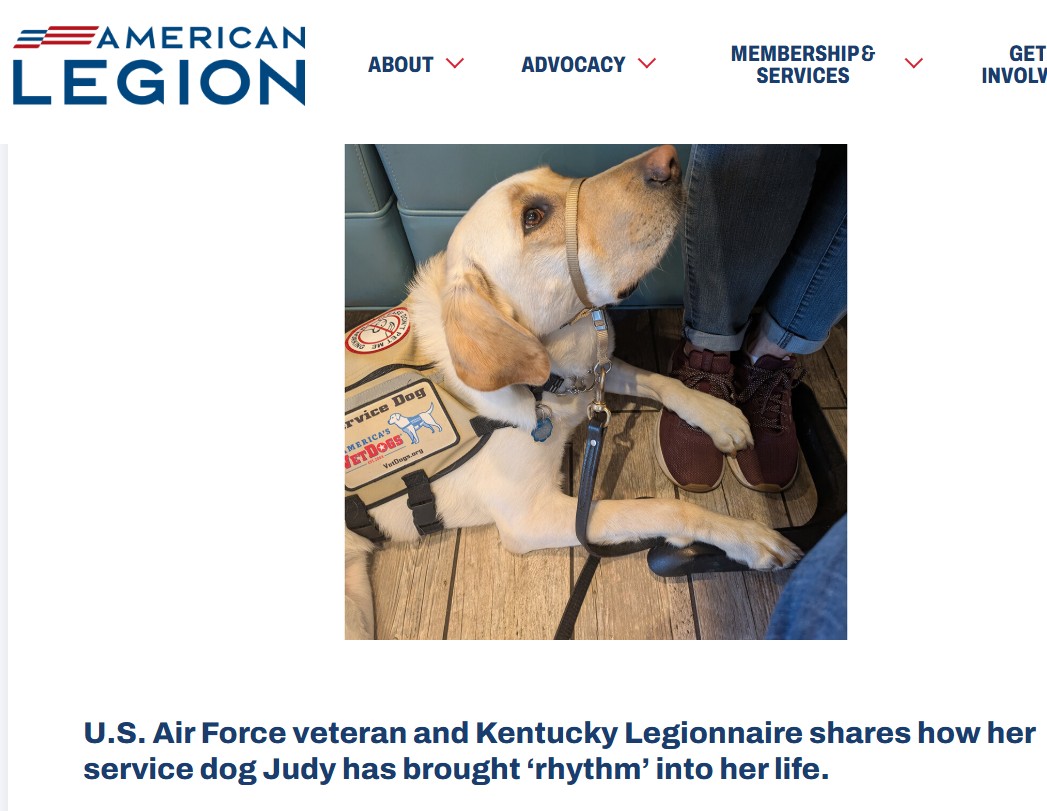 The American Legion published an article I submitted about my service dog, Judy, and the rhythm and stability she has brought into my life. In introducing myself to this audience of military veterans, I included my VA disability rating. What I wrote was factual and understandable in the context of a veterans organization. But after the article was published, a friend who is a veteran contacted me and commented that it was brave of me to be so transparent. Her words made me think about the language I used to describe myself.
An administrative determination can be accurate and serve an important purpose without becoming an identity. A disability rating can document service-connected health conditions related to injury or toxic exposure and provide access to benefits and medical support. I can acknowledge that reality without allowing it to answer a much deeper question: Who am I? I am a veteran. I experience health challenges. I have a service dog who helps me. But above all of those descriptions, I am a beloved daughter of God.
Interestingly, this past summer when Judy and I recertified as a team, I was already wrestling with this question. I asked an America’s VetDogs field representative, “If my health gets worse, will Judy still be my dog?” She told me yes. Then I asked the question that mattered just as much to my faith: “If there is a creative miracle and God instantly heals me, will Judy still be my dog?” Again, the answer was yes.
Looking back, I realize I had unknowingly asked whether Judy belonged only to the disabled version of me. The answer was no.
There is tremendous freedom for me in those two answers. Judy belongs in my life; disability does not have to become my name. I do not have to remain attached to an identity of illness to justify her presence in my life. Neither do I have to deny what I am experiencing today to believe God for something different tomorrow. I can gratefully receive the support I need today while keeping my hope anchored in Christ.
There is a difference between participating in healing and organizing my identity around defeating illness. Acceptance does not mean saying, “I guess this is my life forever.” Nor does it mean giving up on healing or ignoring what my body needs. It means acknowledging, This is what I am experiencing right now, and I do not have to postpone living until it disappears.
I can experience pain and read a book. I can experience fatigue and write for twenty minutes. I can feel uncertainty after a medical appointment and still spend time with someone I love. I can pursue goals that reflect what matters to me while honoring my body’s need for recovery. Sometimes faith looks less like trying harder and more like putting something down.
As Christians, our faith adds another dimension because we believe in Christ’s provision for healing. Isaiah 53:5 (WEB) tells us, “But He was pierced for our transgressions. He was crushed for our iniquities. The punishment that brought our peace was on Him; and by His wounds we are healed.” Yet even the pursuit of healing can become another place where we evaluate ourselves: If I still hurt, am I failing to believe correctly? If symptoms returned today, did I lose ground? Do I need to pray more, research more, or try harder? That simply creates another scoreboard.
I am learning instead to align my testimony with Scripture. I can acknowledge, Pain is present today, without making pain the final word. I can say, My body is struggling today, and I am still God’s beloved daughter. I do not understand everything happening in my body, and uncertainty does not get to rename me. I can receive medical care without making disease my identity. I can believe for healing without making healing my full-time job. That is not denial. It is putting things back in their proper order.
This is not replacing reality with religious language. If something hurts, it hurts. If something was lost, we can grieve it. If something unjust happened, truth matters. A truthful witness does not conceal evidence, but neither does a truthful witness permit suffering to testify beyond what it actually knows.
Pain can testify about pain; it cannot testify about my worth. Trauma can testify about what happened; it cannot determine my identity. A diagnosis can describe a condition; it cannot name my destiny. A disability rating can describe a determination without becoming my name.
Perhaps part of healing is learning to hear every witness with discernment—to honor what is true, refuse what is false, and increasingly bring my own testimony into agreement with God’s. I can pay attention to what hurts without building my life around it. I can receive help without making the need for help my identity. And I can pursue healing without fastening my hope to the pursuit. My hope is in Christ. My pain may have something to say today. I can listen. I just don’t have to give it my name.