Every Book Starts Somewhere
Every book has a beginning, but not every beginning looks impressive.
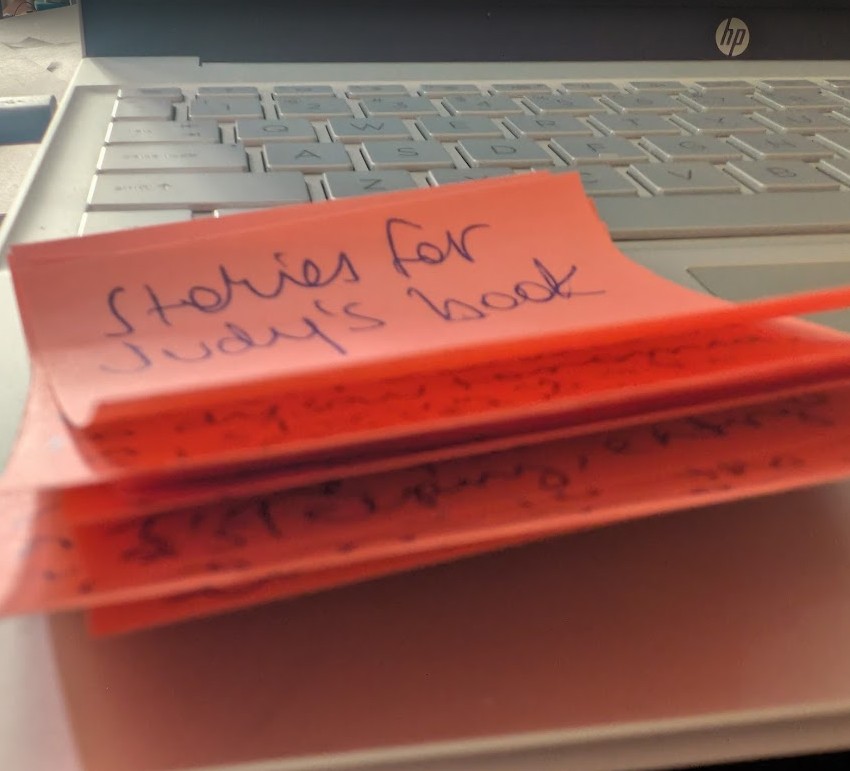 Sometimes a book begins with a completed outline, chapter titles, research notes, and a writing schedule. Sometimes it begins with a folder on a computer filled with scattered thoughts, half-written chapters, and documents named things like “Book Idea Final Version.” And sometimes, as in my current season, a book begins with colorful sticky notes.
That may not sound very official, but I have learned not to discount small beginnings.
Right now, I am tracking potential stories for an upcoming book, volume two in a series. I am not sitting down every day to draft full chapters yet. I am not forcing the manuscript before it is ready. I’m simply paying attention. I’m listening for God’s directions. When an idea, anecdote, lesson, or story comes to mind, I jot it down on a sticky note. Eventually, those notes will find their way into a folder. When I have collected at least thirty story ideas, I will sit down and begin adding more details.
For this particular project, I know what I need before I can move forward. I need at least twenty viable stories of a predetermined length, written in the same format and style used in volume one. That means not every idea will make the final cut, and that’s okay. The gathering stage is part of the process. The incubating stage is part of the process. These quiet, almost invisible stages are still part of the process.
Some people might look at a stack of sticky notes and think, “That is not a book.” But I know better. This is often how God begins projects in me. A nudge. A thought that will not leave. A lesson that keeps returning. A moment I sense I am supposed to remember. Before there is a manuscript, there is often a stirring. Many Christian writers share this same experience.
Comparison is a thief. Many writers become discouraged because they compare their beginning to someone else’s finished product. They see the published book, the polished cover, the organized launch, and the glowing reviews. What they do not see are the scraps of paper, the confusing first drafts, the prayers for direction, the deleted paragraphs, the research rabbit trails, or the long stretches where the work looks like nothing is happening.
But something is happening.
Ideas are taking shape. The message is maturing, and the writer is becoming ready to carry it to term. There is wisdom in not rushing through that part.
At the same time, there is also wisdom in not allowing the process to become overwhelming. Those are two different things. Moving slowly and prayerfully is not the same as being paralyzed. Waiting for clarity is not the same as avoiding the work. Letting a book incubate is not the same as abandoning it.
When I first started self-publishing, I learned many valuable lessons the hard way as my investments in time, energy, and resources, didn’t always pan out. I didn’t know what I didn’t know, so I made a lot of decisions I wouldn’t make today. Beginning writers are bombarded with information and options for preparing a manuscript, choosing publishing options, organizing the business side, understanding tax considerations, working through editing, and marketing a finished book.
My notes on writing, editing, and publishing, grew as I continued to learn. People started asking me for guidance and direction. Those experiences are part of why I wrote The Complete Beginner’s Guide to Self-Publishing for Christians. I wanted to help faith-based writers understand the practical steps of self-publishing while also making room for spiritual direction. That guide includes journaling prompts for seeking God’s guidance, as well as specific help for authors writing in religious or spiritual genres, such as devotionals, testimonies, and other faith-based works. It also addressed things like quoting Scripture references and reaching faith-based outlets.
One particularly grumbly stranger was compelled to leave negative public review without reading the book or the content blurb to learn more. He took offense at the title saying “for Christians,” and said the content should have been available for everyone. I later created Self-Publishing Simplified: Your Step-by-Step Guide to Success, which includes the same core information for a broader audience writing in other genres, but without the faith-based references.
Both books grew out of a desire to help new authors avoid unnecessary confusion and costly pitfalls. But the heart behind them is not, “Look what I know.” The heart is, “I remember what it felt like to be new, and I want to make the road clearer for someone else.”
That is also how I feel about this current project. I am still at the sticky-note stage. I’m collecting the pieces, and listening for what matters. No hurry. I’m trusting that, in time, the shape of the book will become clearer.
Maybe you are there too.
Maybe your next project is not a manuscript yet. Maybe it is a folder, a journal, a note in your phone, a voice memo, or a sentence scribbled on the back of an envelope. Maybe it does not look like much right now. Do not despise it.
Everyone starts somewhere.
There is no need to hurry through any of the writing, editing, or publishing stages just to prove the project is real. There is also no reason to let the size of the finished dream intimidate you into doing nothing. Start with the next faithful step. Write the note. Save the idea. Ask the question. Gather the story. Pray for direction. Learn what you need to learn.
Your story does not have to be fully formed today for you to begin stewarding it well. Sometimes the smallest notes are seeds and when tended faithfully, those seeds become books. Your book, in God’s hands, leaves a legacy capable of reaching further and having lasting impact on generations of readers.
.png "Maggie's Legacy")